
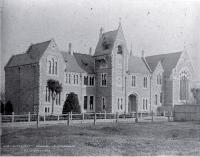
[ca. 1882], CCL PhotoCD 1, IMG0012
British beginnings
Mountfort was born on 13 March 1825. He grew up in Birmingham, England, and studied architecture with Richard Cromwell Carpenter. Carpenter was an important member of the Gothic Revival movement and was a strong influence on Mountfort’s architectural style.
Arriving in Canterbury
On 20 August 1850, Mountfort married Emily Newman. He travelled with his new wife on board the Charlotte Jane to Canterbury, arriving on 16 December 1850.
His first design in New Zealand was for the Church of the Most Holy Trinity in Lyttelton. Unfortunately, unseasoned (not fully dried) timber was used, and after strong winds had buffeted it, it was decided that the church was not safe and it was demolished in 1857. This incident did not help Mountfort’s career at first, although it was his knowledge of local timber and conditions that was the problem, not his skill as an architect. Until 1859 he ran a bookshop and worked as a drawing teacher. In that time he designed two more churches.
Architect to the province of Canterbury
By 1857 Mountfort and his partner and brother-in-law, Isaac Luck, had become architects to the province of Canterbury. Together they designed the new Canterbury Provincial Council Buildings, built between 1858-1865. The stone chamber (built in 1865) is thought of as the most important example of Mountfort’s work.
When the construction of ChristChurch Cathedral began in 1863, the English architect, George Gilbert Scott, recommended Mountfort for the job of supervising architect (looking after the day-to-day work on the building site). The Cathedral Commission insisted on an architect from England instead. After the building had been delayed because of money problems, Mountfort was made supervising architect when work finally started again in 1873.
New Zealand’s leading church architect
Other buildings designed by Mountfort were the Canterbury Museum (1869-1882), Canterbury College (now the Arts Centre), which included the clock-tower block (1877) and the Great Hall (1882). Nowhere else in New Zealand has there been a collection of public buildings in the Gothic Revival style.
He was elected president of the Canterbury Association of Architects when it was formed in 1872. By the 1880s Mountfort was recognised as the country’s leading church architect, with the design of over forty churches to his name.
Benjamin Mountfort died on 15 March 1898, in Christchurch.
Status of Mountfort’s buildings post-quakes
Several of the buildings designed by Mountfort were damaged in the earthquakes of 2010 and 2011. The status of some of his most well-known buildings is listed below:
- ChristChurch Cathedral — significantly damaged; following a legal battle it was decided in July 2013 to continue with demolition but this was later halted. In September 2017 the decision was made to restore the Cathedral.
- Canterbury Museum — survived the earthquakes in good condition, largely as a result of earthquake strengthening carried out in the early 1990s. Following some temporary closures the Museum fully reopened in April 2013.
- Canterbury Provincial Council Buildings — significantly damaged; fate uncertain. Prioritised for funding, the chambers have been stabilised with repair options being considered.
- Canterbury College (now the Arts Centre) — significantly damaged. Several of the building have been repaired including The Great Hall but the overall restoration of the centre is expected to cost more than $200 million and take 15 years. The Registry building and Gym have also reopened.
- Trinity Congregational Church (Octagon Live restaurant) — repairs planned.
- Church of the Good Shepherd, Phillipstown — demolished.
- Mountfort Cell Block (now Jailhouse Accommodation) — no damage incurred.
- St Paul’s Anglican Church, Papanui - repairs and restoration completed in mid-2013. The church was where Lord Ernest Rutherford married Georgina Newton in 1900. Many prominent Cantabrians are buried in its graveyard including Sir Robert Heaton Rhodes and Captain Charles Hazlitt Upham.
Information about Mountfort-designed buildings belonging to the Christchurch City Council can be found in its Facilities Rebuild Plan.
Sources
- Ian J. Lochhead. Mountfort, Benjamin Woolfield — Biography, from the Dictionary of New Zealand Biography. Te Ara - the Encyclopedia of New Zealand, updated 1-Sep-10
- Dictionary of New Zealand biography, Vol. 1, 1769-1869. Wellington, 1990.
Find out more about Mountfort and the Gothic Revival
In our catalogue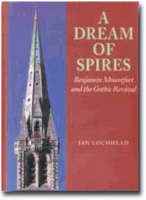
Related pages
- The Arts Centre
- The Canterbury Museum
- Canterbury Provincial Council Buildings
- Image collection: Gothic Revival
Other websites
- B.W. Mountfort and the Gothic Revival: A Centennial Exhibition at the Christchurch Art Gallery
- Mountfort, Benjamin Woolfield: Ian J. Lochhead. 'Mountfort, Benjamin Woolfield', from the Dictionary of New Zealand Biography. Te Ara - the Encyclopedia of New Zealand, updated 30-Oct-2012
- Gothic Revival by Georg Germann and Pippa Shirley. Grove Art Online. Oxford Art Online.
