Riccarton Bush
On his deathbed in 1854, John Deans asked that his wife Jane make sure that Riccarton Bush was preserved forever.
As a result Riccarton Bush is probably the oldest protected natural area in the country. It is a reminder of what the Canterbury Plains would have looked like before human settlement. The trees are mostly kahikatea (between 400 and 600 years old), totara, matai, kowhai, hinau and other species. Native climbing plants and a wide range of ferns and mosses are also found there.
The native bird population has dropped in number since the arrival of the European settlers. Fossil records show that kiwi, takahe and moa once lived there. With the clearing of almost three-quarters of the original pre-European bush, the native bird-life declined. The most common birds there now are introduced species, such as sparrows, blackbirds, thrushes and starlings.
Introduced animals have not helped the native bird and insect populations. Australian brush-tailed possums arrived around 1900, 12 hedgehogs escaped from Merivale in the 1890s, rabbits were introduced in the 1850s, and rats (Norway and ship) and mice have been in New Zealand since the beginning of the nineteenth century. They all inhabit the Bush.
Riccarton Bush was first seen by Captain Barney Rhodes in 1836 when he climbed the hills from Port Cooper and looked at the plains beyond.
It is shown clearly in maps drawn as early as 1845, and in Charles Torlesse's detailed survey map of Canterbury in 1849. It was a favourite subject of early artists as well.
Before European settlement, Putaringamotu was a valuable source of food and timber for the Māori. From the bush they produced carvings, canoes, and preserved pigeons.
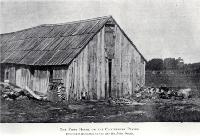
For the first Pakeha the bush was a source of shelter and building timber and firewood.
In the 1848 Christmas Day agreement signed between the Deans brothers and the agents for the Canterbury Association, Captain Thomas and William Fox, the Deans gave up half of what was now to be known as Riccarton Bush, to provide timber and firewood for the new settlers.
By July 1851 the Christchurch settlers had cut down all the standing timber in their half of the bush. Papanui Bush was cleared completely by 1861, and other patches of bush at Hoon Hay, Halswell, Tai Tapu, Woodend, Rangiora, Ohoka and Tuahiwi had almost disappeared by 1870.
The Deans used the timber in their half of Riccarton Bush carefully. Some kahikatea and matai was used for the framing and weatherboarding of buildings at Riccarton, and later at Homebush, but only fallen or dead timber was used for firewood and fencing.
Twice in the early days of Christchurch fires came close to the Bush. Jane Deans planted introduced trees around the edge of the Bush to protect it from wind. These exotic trees have gradually been removed in recent years.
In 1914 the Deans family presented the remaining 15.7 acres of Riccarton Bush to the people of Canterbury, on condition that it be preserved for all time in its natural state.
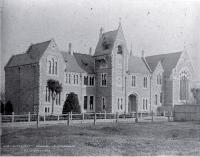
A Board of Trustees was set up according to the Riccarton Bush Act of 1914 and the bush was opened to the public on 24 February 1917. The area around the bush was extended when the Christchurch City Council bought Riccarton House from the Deans family in 1947. The Deans Cottage, the oldest surviving building on the Canterbury Plains, is also sited there.
Sources
- Ogilvie, Gordon. Pioneers of the Plains: the Deans of Canterbury. Christchurch, 1996