
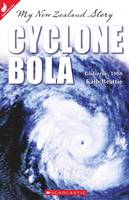
 Cyclone Bola struck the Hawke’s Bay and the Gisborne / East Cape region on the East Coast of the North Island on 7 March 1988. It was one of the most damaging cyclones to hit New Zealand. The cyclone slowed as it moved over the area, resulting in over three days of torrential rain. The rain caused devastating floods and slips, resulting in the evacuation of thousands of people and the death of 3 persons.
What happened?
When Cyclone Bola struck on Monday 7 March, 1988, the East Coast of the North Island suffered devastating floods. The torrential rain had been falling since 6 March, and continued for three days non-stop. Winds of up to 100 kilometres per hour toppled trees and tore off roofs. Heavy rain in the area resulted in landslides, cuts to power and sewage services, and closed a number of roads.
Three people died when the car they were in was swept away by floodwaters. Two other occupants of the car were saved.
Many people were evacuated from their homes – 3,000 in Gisborne, 300 in Wairoa, and 400 at Te Karaka, when the swollen Waipoa River came close to flooding the township.
Floods accompanying Cyclone Bola threatened to overtop the river banks and inundate the Hawke’s Bay town of Wairoa on 7 March 1988. The central span of the bridge across the Wairoa River was washed away. It was a serious blow: the bridge linked the two sides of the town and carried the water supply and sewerage pipes.
The state highway was closed in several places by slips and flooding. When people in one house could not be evacuated by helicopter, horses were brought in to get them out. States of emergency were declared in Wairoa, Gisborne and the East Cape. In Gisborne, the water pipeline from the supplying dams was lost.
The force of Cyclone Bola was also felt in Northland. With the torrential rain came flooding and cuts to power and telephone lines. A state of emergency was declared in Dargaville, and the main water supply was disrupted when the line carrying the water was washed away with a bridge.
How many died?
Three people died.
Other events and outcomes
A Disaster Relief Committee was set up to assess the damage caused by the storm on the East Coast.
A peak rainfall of 916 millimetres over the three days was recorded inland from Tolaga Bay. The most intense rainfall was on the steep hill country of the East Coast. Most of the damage happened in places where there had been little or no soil conservation work or flood control schemes.
The floods affected approximately 3,600 hectares of farming and horticultural land. Losses to horticulture and farming were estimated to have reached $90 million. 1765 farmers were affected by damage to their land and crops or stock losses. In some places Cyclone Bola arrived just as harvesting was due to start.
Repairs to the water supply in Gisborne were estimated to cost $6.6 million, and the damage to forests on the East Coast was estimated at $8.6 millions.
An inquiry into flood management followed the cyclone, and made a number of recommendations. These included soil conservation work, river control and management, and land use planning. These measures were to be applied to all of New Zealand in an attempt to reduce the impact of future floods.
What is a cyclone?
A cyclone is formed in the tropics when cold air and warm air meet: the cold air pushes under the warm air, making it rise. Cyclone, hurricane and typhoon are all different names for a rotating tropical storm. Around Australia, the South Pacific and the Indian Ocean the storms are known as cyclones.
The storm begins to pull in humid air from the warm ocean water, and the winds begin to swirl around and around, drawing in more air. In the southern hemisphere the wind flows clockwise (anti-clockwise or counter-clockwise in the northern hemisphere) in the low air pressure part of the storm near the earth’s surface.
For the storm to grow into a hurricane or cyclone there must be a combination of low air pressure near the earth’s surface, and high air pressure at a higher altitude. As the wind strengthens it gets to the point where it cannot go any faster, and so it rises until it meets the high air pressure area of the storm. In this high air pressure area the air flow is anti or counter-clockwise in the southern hemisphere (the opposite in the northern hemisphere). As the air rises, the direction of the flow changes, and the air is swept outwards, away from the centre of the cyclone.
Huge storm clouds develop which swirl with the wind, and can grow to a height of more than 15,000 metres. The centre of the storm is known as the “eye” and usually it is calm with no rain and little wind.
More information and sources
- Southland floods and Cyclone Bola, Te Ara Encyclopedia of New Zealand, accessed 19 October 2012.
- Cyclone Bola footage from TVNZ, Te Ara Encyclopedia of New Zealand, accessed 19 October 2012.
- When Bola bore down on Gisborne, The New Zealand Herald, March 3 2013
- Search our catalogue for information about Cyclone Bola
- Search our catalogue for information about hurricanes
Disasters
- Go to our page on New Zealand disasters
- Read some true kids books about disasters
- Read some true adult books about disasters
- Read some stories about New Zealand kids in disasters
